
Cannabis licence holders in Canada should pay close attention to two facts that can easily be misunderstood together.
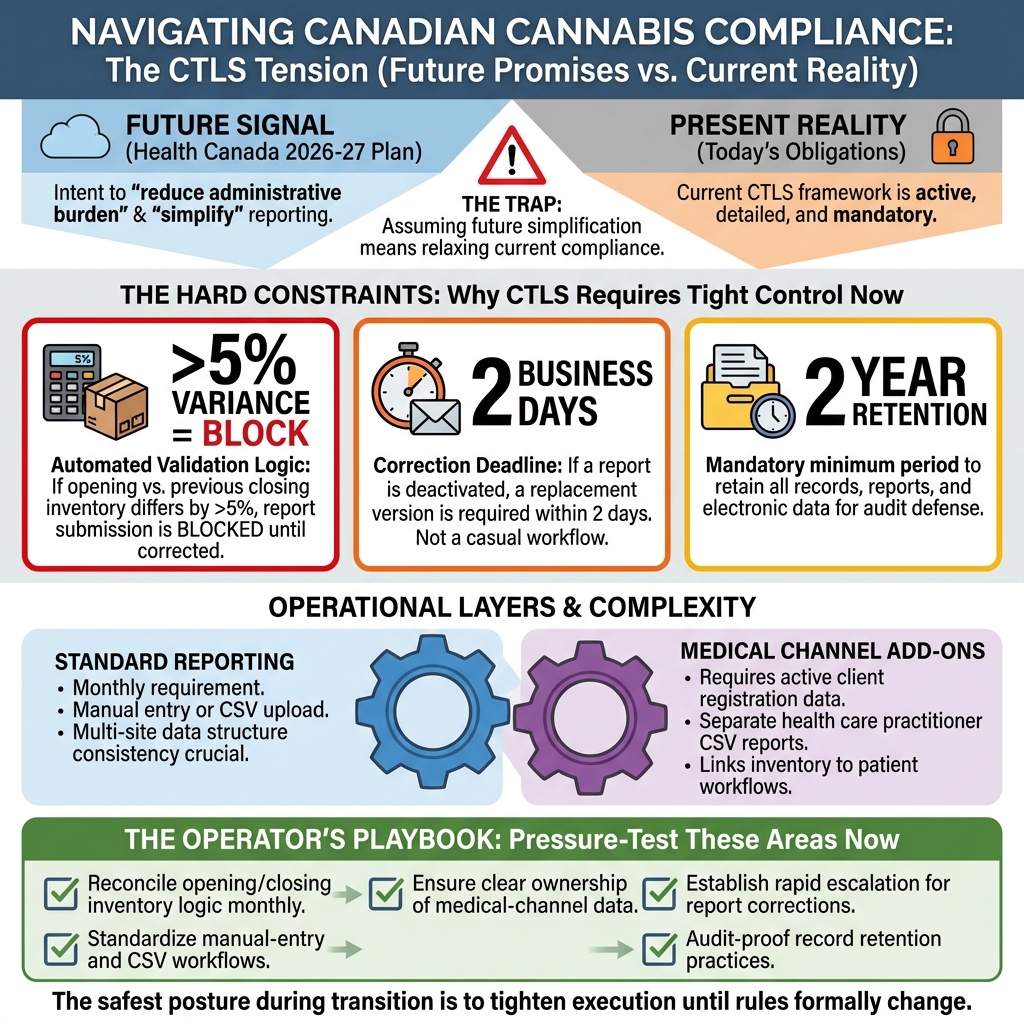
First, Health Canada’s 2026-27 Departmental Plan says the department intends to reduce administrative burden on cannabis licence holders and regulated parties, including exploring how to simplify cannabis supply chain reporting requirements.
Second, none of that changes the reality that the current Cannabis Tracking and Licensing System reporting framework is still active, detailed, and operationally important today.
That tension is where many organizations get sloppy.
When teams hear “simplification,” they can drift into assuming the present system matters less. In practice, the opposite is usually true. During transition periods, the safest posture is to tighten current execution until rules actually change.
What CTLS reporting still requires right now
Health Canada’s reporting guidance for cultivation, processing, and sale for medical purposes licence holders makes it clear that monthly reporting is still a standing obligation.
The guidance says a cannabis tracking report is expected each month and can be submitted either:
- by manual entry in the CTLS
- by uploading a CSV file in the CTLS
It also notes that licence holders with multiple sites can report on them all in a single CSV file upload, which is helpful operationally but also increases the importance of consistent data structure and site-level controls.
That means the reporting burden is not only about knowing the rules. It is about having a system that can produce reliable data every month without improvisation.
Why data-quality failures get expensive quickly
One of the most useful details in Health Canada’s reporting guidance is the automated variance validation logic in the CTLS.
If there is more than a 5% variance between the opening inventory of the current month and the closing inventory of the previous month, the system displays an error and the report cannot be submitted until the data is corrected to fall within the accepted range.
That is not a minor technical nuisance. It is a signal of how the reporting system actually works in practice:
- your records need to reconcile
- your inventory logic needs to be stable
- your reporting team needs to understand what the system will reject
For operators, this means reporting readiness is really an SOP and controls question. If inventory logic is loose upstream, CTLS reporting becomes the place where the weakness finally becomes visible.
Medical-reporting obligations make the system even more operational
The guidance also reminds licence holders that sale-for-medical-purposes businesses may have to submit specific medical data each month.
Health Canada says holders of a licence to sell cannabis for medical purposes are expected to include information about active client registrations and, where applicable, submit separate health care practitioner reports by CSV file upload.
That matters because it shows the CTLS is not only a generic supply-chain system. For some operators it is also tied to medical-channel documentation and reporting discipline.
If a business serves the medical market, CTLS accuracy is tied not only to inventory controls but also to patient-registration workflows and document-linked reporting.
Deactivation and correction are not casual workflows
Another important operational point in the reporting guidance is what happens when a previously submitted report needs to be changed.
Health Canada says the system will only accept a report for the current month if a report for the previous month is active in the system. If a report is deactivated, the replacement version must be submitted before the next report can be filed.
The guidance also says Health Canada will action the deactivation request in the system and the licence holder will receive an email confirming that a replacement report is required within 2 business days.
That is a strong reminder that reporting correction is not something organizations should treat casually. If changes are needed, the process needs ownership, clarity, and speed.
Record retention still matters even if simplification comes later
Health Canada’s reporting guidance also says reporting parties are required to retain copies of all records, reports, electronic data, and other documents for at least 2 years beginning on the day the information is provided.
This is important because simplification conversations can sometimes cause teams to focus only on future-state process design. But the current framework still expects defensible retention and traceability.
That is why 2026 should not be used as a year to “wait and see” on reporting discipline. It should be used as a year to get control over:
- report ownership
- data lineage
- inventory reconciliation
- CSV file integrity
- change control
- retention practices
What Health Canada’s 2026-27 simplification signal really means
The Departmental Plan language is still meaningful. Health Canada did say it plans to reduce administrative burden on cannabis licence holders and explore ways to simplify supply chain reporting requirements.
That matters because it suggests the department understands that compliance effectiveness and administrative friction are not the same thing.
But there is a critical distinction between:
- a policy direction to simplify
- an implemented change that relieves current obligations
As of April 4, 2026, operators still need to run against the live CTLS framework and guidance. Until the rules, forms, or reporting system actually change, the practical standard is the existing one.
What operators should tighten now
The best 2026 response is not to guess the future shape of reporting. It is to reduce current process fragility.
Licence holders should be pressure-testing:
- whether opening and closing inventory logic reconciles cleanly every month
- whether manual-entry and CSV workflows are standardized
- whether multi-site reporting structures are internally consistent
- whether medical-channel data is owned clearly
- whether report corrections can be escalated fast
- whether records are retained in a way that can survive audit or inquiry
If simplification comes later, those companies will benefit. If it takes longer than expected, they will still be protected.
FAQ: CTLS reporting Canada
Do cannabis licence holders still have to submit CTLS reports every month?
Yes. Health Canada’s current guidance says a cannabis tracking report is expected each month.
Can CTLS reports be submitted by CSV upload?
Yes. The guidance says federal licence holders can submit reports either manually in the CTLS or by CSV upload.
What happens if inventory numbers do not reconcile?
The system applies automated variance validation. If the opening and closing inventory difference exceeds the accepted range, the report cannot be submitted until corrected.
Does Health Canada’s 2026-27 simplification plan reduce current reporting obligations?
No. It signals a policy direction, but current CTLS obligations still apply unless and until the reporting framework is formally changed.
In 2026, CTLS reporting is not just an admin task. It is a live control system. The companies that treat it as operational infrastructure, not back-office paperwork, will be better prepared for both today’s obligations and tomorrow’s changes.
Sources
- Health Canada, Cannabis Tracking and Licensing System reporting guide for cannabis cultivation, processing and sale for medical purposes licence holders: Before you start submitting
- Health Canada, Cannabis Tracking and Licensing System reporting guide for cannabis cultivation, processing and sale for medical purposes licence holders: Submit your reports
- Health Canada, 2026-27 Departmental Plan
- Health Canada, Getting started guide: Cannabis Tracking and Licensing System (CTLS)