
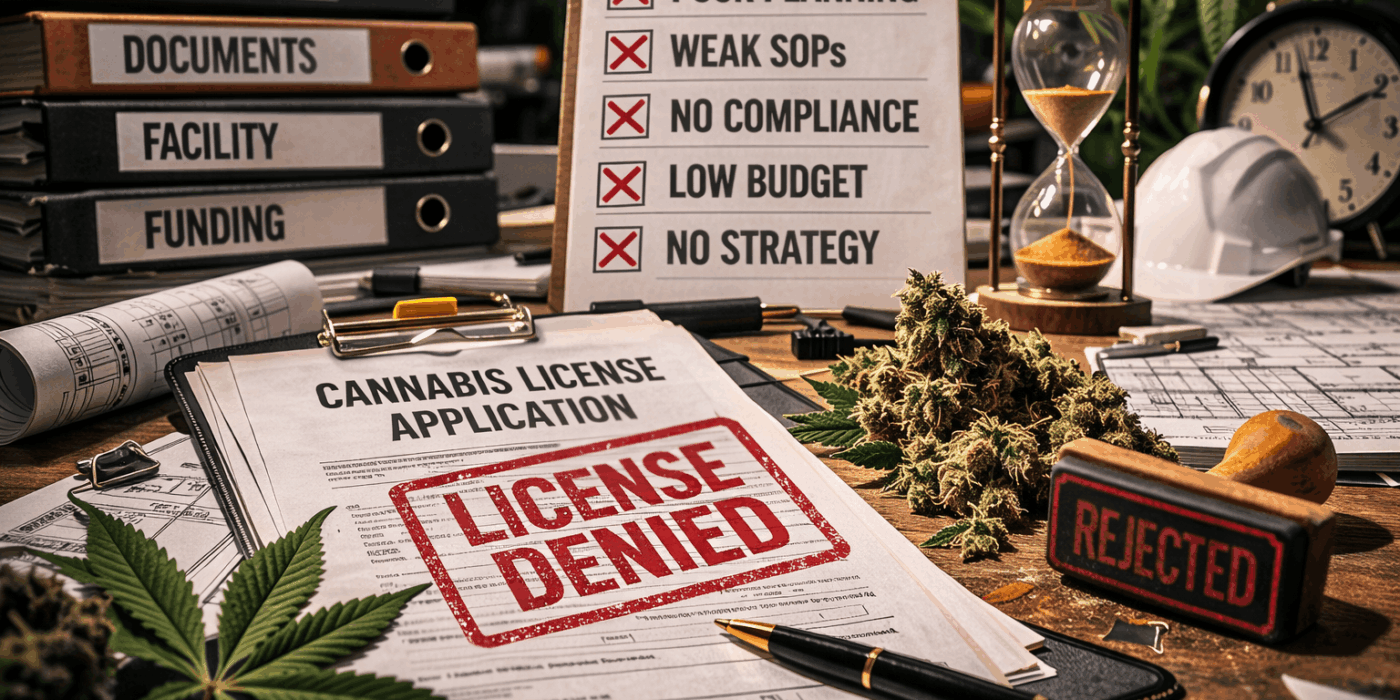
One of the most common misunderstandings among new entrants is the perception that a cannabis license is simply a regulatory permit.
In most jurisdictions, including Canada and Europe, regulators do not evaluate intentions. They evaluate the applicant’s ability to operate a compliant facility immediately after licensing.
Health Canada, for example, requires applicants to demonstrate that key elements of the operation are already built and validated before the license is issued. Similarly, in Europe, regulators expect a fully structured quality system, validated procedures, and traceable supply chains before any product enters the medical market.
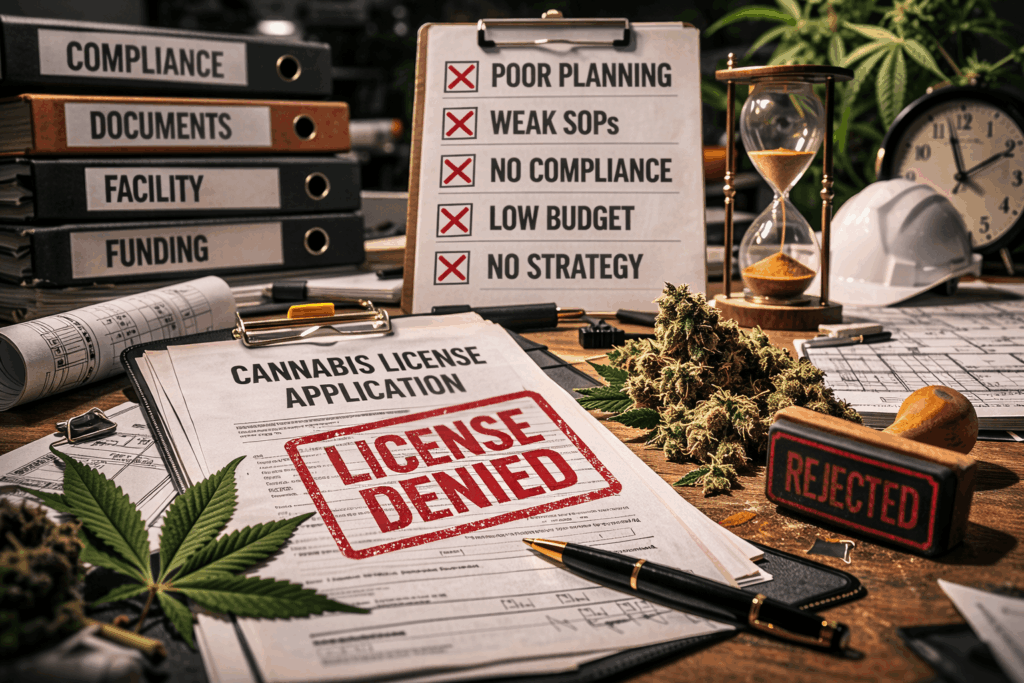
In practical terms, this means that obtaining a cannabis license requires:
• a compliant facility design
• defined operational workflows
• documented Standard Operating Procedures (SOPs)
• a functional quality management system
• traceability and record keeping infrastructure
Projects that treat licensing as a preliminary administrative step are often surprised by the depth of documentation and operational preparation required.
Failure Point #1: Poor Facility Planning
The physical layout of the facility is one of the most critical components of a cannabis license application.
Many projects begin with a building or agricultural site that was not designed for regulated production. Entrepreneurs then attempt to retrofit the space without fully understanding the regulatory implications.
Common issues include:
• inadequate workflow separation between clean and non-clean areas
• insufficient secure storage for cannabis materials
• poor access control design
• missing quarantine or destruction areas
• improper airflow management
These problems often appear during regulatory review or inspection, forcing costly redesigns.
In regulated industries, the facility is not just a building—it is a controlled process environment. Every movement of materials, people, and products must be accounted for.
A poorly designed facility can delay a license application by months or even years.
Failure Point #2: Weak Standard Operating Procedures (SOPs)
Standard Operating Procedures are the backbone of compliance in regulated cannabis operations.
Unfortunately, many early-stage projects underestimate the importance of SOP development. Some founders copy generic templates from the internet, while others attempt to write procedures without having operational experience.
Regulators can immediately identify weak SOP systems.
A robust SOP framework should describe, in detail:
• cultivation and plant care procedures
• sanitation and contamination control
• record keeping requirements
• inventory management and traceability
• employee training protocols
• deviation and corrective action processes
More importantly, SOPs must reflect the actual workflow of the facility.
When SOPs exist only as paperwork rather than operational instructions, regulatory inspectors will identify inconsistencies between documentation and reality.
This is one of the fastest ways to lose credibility during a licensing review.
Failure Point #3: Underestimating Compliance Infrastructure
In many ways, cannabis businesses resemble pharmaceutical operations more than traditional agricultural ventures.
This is particularly true in medical markets such as Canada and Europe, where quality assurance systems are essential.
A functional compliance framework typically includes:
• a designated Quality Assurance Person or compliance lead
• document control systems
• batch records and traceability logs
• supplier qualification processes
• internal audit mechanisms
Entrepreneurs sometimes assume that these systems can be implemented after the license is obtained.
In reality, regulators often expect these structures to exist before the license is granted.
Without them, the entire application may stall.
Failure Point #4: Insufficient Capital Planning
Another frequent cause of project failure is financial underestimation.
Cannabis licensing requires significant upfront investment before any revenue is generated.
Typical pre-license expenses include:
• facility construction or retrofit
• security systems and monitoring infrastructure
• regulatory consulting and documentation preparation
• laboratory testing and validation
• staffing and compliance personnel
Many founders budget for construction and equipment but fail to allocate sufficient resources for regulatory preparation and operational validation.
As licensing timelines extend, cash flow pressure increases. Projects then stall before reaching the final regulatory approval stage.
For investors, this is a critical signal. A project with insufficient capital to reach licensing readiness carries substantial execution risk.
Failure Point #5: Lack of Regulatory Strategy
Finally, some projects fail simply because they do not understand the regulatory strategy required to enter the industry.
Cannabis regulation varies widely across jurisdictions.
A licensing strategy that works in Canada may not work in Germany. A cultivation-focused model may not be viable in markets where importation dominates supply. Similarly, certain product categories may face stricter pharmaceutical requirements than others.
Successful projects typically begin with a clear regulatory roadmap that defines:
• target markets
• licensing category and regulatory framework
• supply chain structure
• quality certification pathway (such as GACP or EU-GMP)
Without this strategic foundation, entrepreneurs often spend significant capital building infrastructure that does not align with regulatory expectations.
What Successful Cannabis Projects Do Differently
The projects that successfully reach licensing—and ultimately become operational—tend to follow a very different approach.
Rather than starting with the product or the brand, they start with compliance architecture.
Successful projects typically:
• design the facility around regulatory workflows
• develop SOPs that mirror real operational processes
• implement quality systems early in the project
• secure sufficient capital to reach licensing readiness
• build a clear regulatory strategy aligned with target markets
In short, they treat cannabis as a regulated industry first and a commercial opportunity second.
The Industry Is Maturing — And Regulators Expect Professionalism
The global cannabis industry is entering a new phase.
Early legalization markets were defined by rapid growth and experimentation. Today, regulators expect a higher level of professionalism from operators entering the sector.
Licensing authorities increasingly evaluate not only whether an applicant meets minimum requirements, but whether the project demonstrates long-term operational stability and regulatory maturity.
Entrepreneurs and investors who recognize this shift early will have a significant advantage.
Those who approach cannabis as a simple agricultural or consumer product venture may find the licensing process far more challenging than anticipated.
Final Thought
In regulated industries, licensing is not simply about obtaining approval.
It is about demonstrating that the organization is capable of operating safely, consistently, and transparently under strict regulatory oversight.
For cannabis entrepreneurs, understanding this reality early can mean the difference between a stalled project and a fully operational business.
True Standard Consulting supports cannabis entrepreneurs and investors with licensing strategy, compliance systems, facility planning, and operational readiness across regulated markets.